Learn smarter, not harder: tricks for every age
Age-specific tricks that make maths, reading and problem-solving feel like play. From counting on fingers for beginners to clever methods for growing minds.
- Finger counting
- Age-specific methods
- Maths tricks
- Problem-solving
- Included in every plan
- 7-day money-back guarantee
- On WhatsApp, no app
- For
- Age 3 to 15
- Time
- A few minutes a day
- You need
- Your two hands, 5 minutes
- Cost
- Included in every plan
What is it?
Short, clever methods that children can learn in minutes and use for life.
Tricks, not tension
Each one is a small “aha”. A child learns a trick, tries it, and feels clever.
Right for the age
A beginner learns to count on fingers. An older child learns a mental shortcut.
Maths, reading and reasoning
Not only numbers: word games and logic puzzles are part of it too.
Understand why it works
We explain why a trick works, so it builds understanding and is not just a party piece.
Example: one trick, step by step
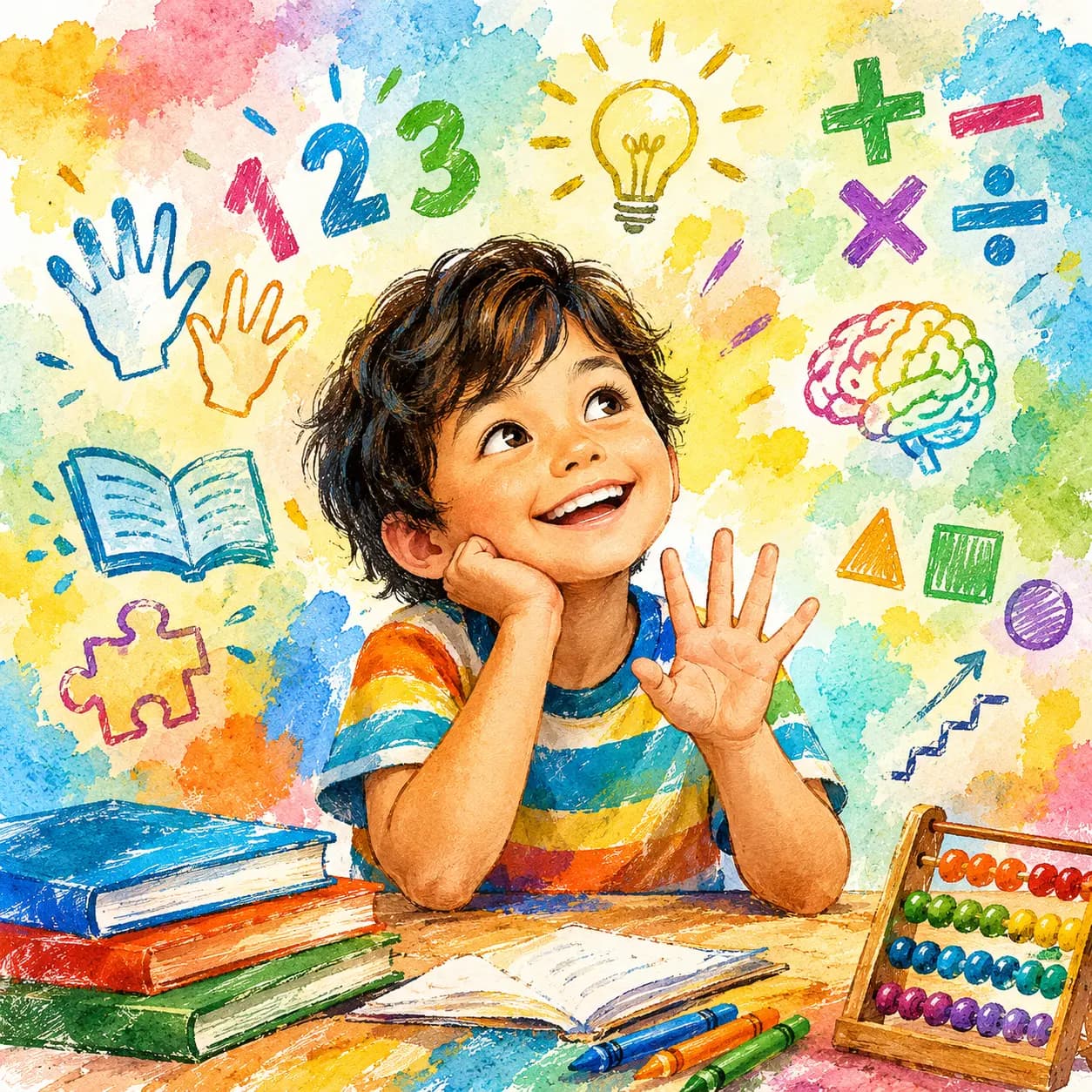
This is the kind of trick that reaches you. (An illustration: the real ones change every day.)
The 9 times table on your fingers
Age 7 to 10You need
- Your two hands
- 5 minutes
What to do
- 1Hold both hands out, ten fingers up. To find 9 × 4, fold down your 4th finger from the left.
- 2Count the fingers to the LEFT of the folded one: 3. That is the tens.
- 3Count the fingers to the RIGHT: 6. That is the ones. So 9 × 4 = 36. Try 9 × 7: fold the 7th finger, and you see 6 and 3: 63.
Ask your child
“Can you find out why it works? (Hint: 9 is one less than 10.)”
What it builds
- Number sense
- Confidence with tables
- Curiosity about patterns
Age by age: what a child learns
The trick grows with the child, and always starts from something they already know.
- Age 3–5
Counting beginners
Fingers, songs and objects.
Examples
- Count to 10 on fingers
- Finger rhymes for numbers
- Sort and count buttons
- Age 6–8
Number friends
Seeing how numbers fit together.
Examples
- Pairs that make 10
- Doubles and near doubles
- Skip-counting in 2s, 5s and 10s
- Age 9–11
Table masters
Tricks for tables and quick sums.
Examples
- The 9 times table on fingers
- Multiplying by 11
- Rounding to estimate
- Age 12–15
Mental mathematicians
Shortcuts that save time and build reasoning.
Examples
- Percentages: find 10% first, then build up
- Squaring numbers that end in 5
- Logic puzzles with clues
Why it matters for children
Many children decide early that “maths is not for me”. A good trick at the right moment can change that feeling.
Less fear of numbers
When maths feels like a game, children stop being scared of it.
Understanding, not only memorising
We show why a trick works. That is how a child starts to see patterns.
Confidence
Teaching a trick to a friend or grandparent makes a child proud and helps them remember it.
Faster thinking
Mental shortcuts make everyday sums quicker and easier.
Beyond the textbook
These are methods and ideas that school books often skip.
A habit of curiosity
“Why does that work?” is the start of a good learner.
- This is not tuition or homework help.
- This is not tricks for showing off: every trick comes with its reason.
More Learning Magic ideas
A few more of the kind of ideas you will find. The real ones change every day.
Count on fingers
Show numbers 1 to 10 on fingers, then add two numbers by showing them on both hands.
Make 10
Find pairs that make 10: 1 and 9, 2 and 8. Say them while clapping.
Double it
Learn doubles (4 + 4), then use them for near doubles (4 + 5).
Skip count song
Sing the 2s, 5s and 10s like a song. Skip counting becomes multiplication later.
Multiply by 11
For 11 × 23, split the digits and add them: 2, 2 + 3 = 5, 3 → 253.
Estimate first
Before adding 48 + 29, round to 50 + 30 and guess. Then check.
Tips for parents
- Ask “why does that work?” after every trick. Understanding is the real magic.
- Let your child teach the trick to you, to a sibling or to a grandparent. Teaching makes it stick.
- Keep it short: one trick, five minutes. Then leave it for a day and ask again.
- Do not worry about speed. Accuracy and understanding come first.
How it works
- 1
Choose a plan
Learning Magic is included in every PaperCandy.Kids plan. There is nothing extra to pay.
- 2
Tell us your child’s age
We pick the right level and the right language: Gujarati, Hindi or English.
- 3
Ideas arrive on WhatsApp
A fresh activity reaches you every day, with a picture and short steps.
- 4
Play together
Put the phone down and play. Each activity shows what to do and what to ask your child.
Ready to try Learning Magic?
Pick a plan, tell us your child’s age, and your first activity arrives on WhatsApp. If you are not happy in the first 7 days, we refund the full amount.