Build, make and explore, with things at home
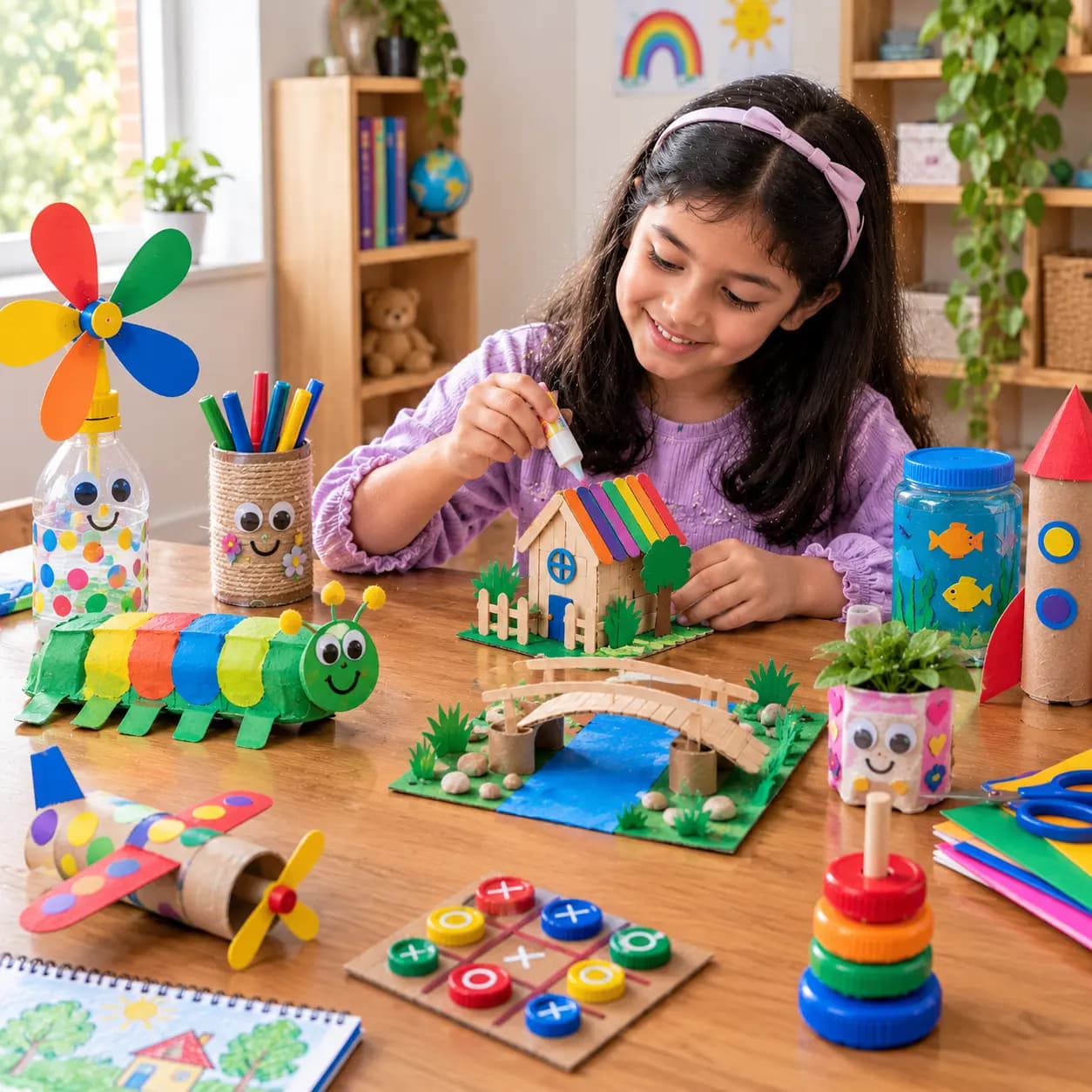
From homemade toys to simple science experiments, hands-on projects turn everyday materials into something amazing. Perfect for curious children who like to make things their own way.
- Homemade toys
- Science experiments
- Everyday materials
- Hands-on learning
- Included in every plan
- 7-day money-back guarantee
- On WhatsApp, no app
- For
- Age 3 to 15
- Time
- A few minutes a day
- You need
- 6 clear cups or glasses, Water
- Cost
- Included in every plan
What is it?
Make-it-yourself projects with clear steps, using what is already in your home.
Make and create
Paper crafts, painted stones, puppets, simple toys: children finish with something they made.
Simple experiments
Safe science with water, colour, air and paper. Children see an idea happen in front of them.
Everyday materials
Paper, cups, string, ice-cream sticks, baking soda. Nothing special to buy.
Do it together
Each project says where a child can lead and where a grown-up helps.
Example: one project, step by step
This is the kind of project that reaches you. (An illustration: the real ones change every day.)
Walking Water Rainbow
Age 5 to 9You need
- 6 clear cups or glasses
- Water
- Food colours: red, yellow, blue
- Paper towels
What to do
- 1Fill cups 1, 3 and 5 with coloured water (red, yellow, blue). Keep cups 2, 4 and 6 empty. Put them in a row.
- 2Fold a paper towel in half and put one end in a full cup and the other in the empty cup next to it. Do this between all the cups.
- 3Wait and watch. The water slowly climbs the paper and mixes into new colours in the empty cups.
Ask your child
“What colour do you think the middle cup will turn? Why?”
What it builds
- Curiosity
- Careful observation
- Predicting
Age by age: what a child makes
Projects get bigger and cleverer as children grow.
- Age 3–5
Little makers
Big, messy, joyful. Done with an adult next to them.
Examples
- Paper-plate animal masks
- Leaf and flower collage
- Colour mixing with finger paint
- Age 6–8
Young scientists
First experiments with a clear “what will happen?”.
Examples
- Walking water rainbow
- A boat that floats and carries coins
- Magnet treasure hunt
- Age 9–11
Builders
Projects with several steps and a result that works.
Examples
- Ice-cream-stick catapult
- A simple pulley from a spool and string
- A pinhole camera from a box
- Age 12–15
Designers
Open challenges with their own design.
Examples
- Marble run from cardboard tubes
- Design a bridge that holds 1 kg
- A solar oven test with a pizza box
Why it matters for children
When children make things with their own hands, they learn that they can build, test and fix.
Thinking like a maker
Planning, trying, seeing it fail and trying again is how real inventors work.
Confidence
“I made this” is a powerful feeling. It makes children brave about the next project.
Fine motor skills
Cutting, folding, gluing and threading train the small muscles used for writing.
Curiosity about how things work
A simple experiment makes a big idea (air, water, force) visible and memorable.
Creativity
There is rarely only one right answer. Children choose colours, shapes and designs of their own.
Time well spent together
Making something side by side is a good way to talk and laugh.
- This is not a craft kit: you do not buy a box. You use what you have.
- This is not homework: nobody is marked.
More Creative Projects ideas
A few more of the kind of ideas you will find. The real ones change every day.
Leaf printing
Paint a leaf and press it on paper to print its veins.
Paper boat race
Fold boats and race them in a tub. Which design floats best?
Baking soda volcano
Mix baking soda and vinegar in a cup for a safe fizzy eruption, outside or in a tray.
Sock puppet show
Make puppets from old socks and perform a short play.
Rainbow in a glass
Layer sugar water of different colours to make a tiny rainbow.
Cardboard city
Turn boxes and tubes into houses, roads and a bridge.
Tips for parents
- Keep a “maker box” with old cartons, string, tape and paper. Children will invent without being told.
- Do the messy part on a tray or newspaper so you can say yes more often.
- Ask “what will happen?” before the experiment starts, and “what did you notice?” after.
- Display what your child made for a few days. It shows their effort matters.
How it works
- 1
Choose a plan
Creative Projects is included in every PaperCandy.Kids plan. There is nothing extra to pay.
- 2
Tell us your child’s age
We pick the right level and the right language: Gujarati, Hindi or English.
- 3
Ideas arrive on WhatsApp
A fresh activity reaches you every day, with a picture and short steps.
- 4
Play together
Put the phone down and play. Each activity shows what to do and what to ask your child.
Ready to try Creative Projects?
Pick a plan, tell us your child’s age, and your first activity arrives on WhatsApp. If you are not happy in the first 7 days, we refund the full amount.