Cheap toys, endless fun: we teach how to play
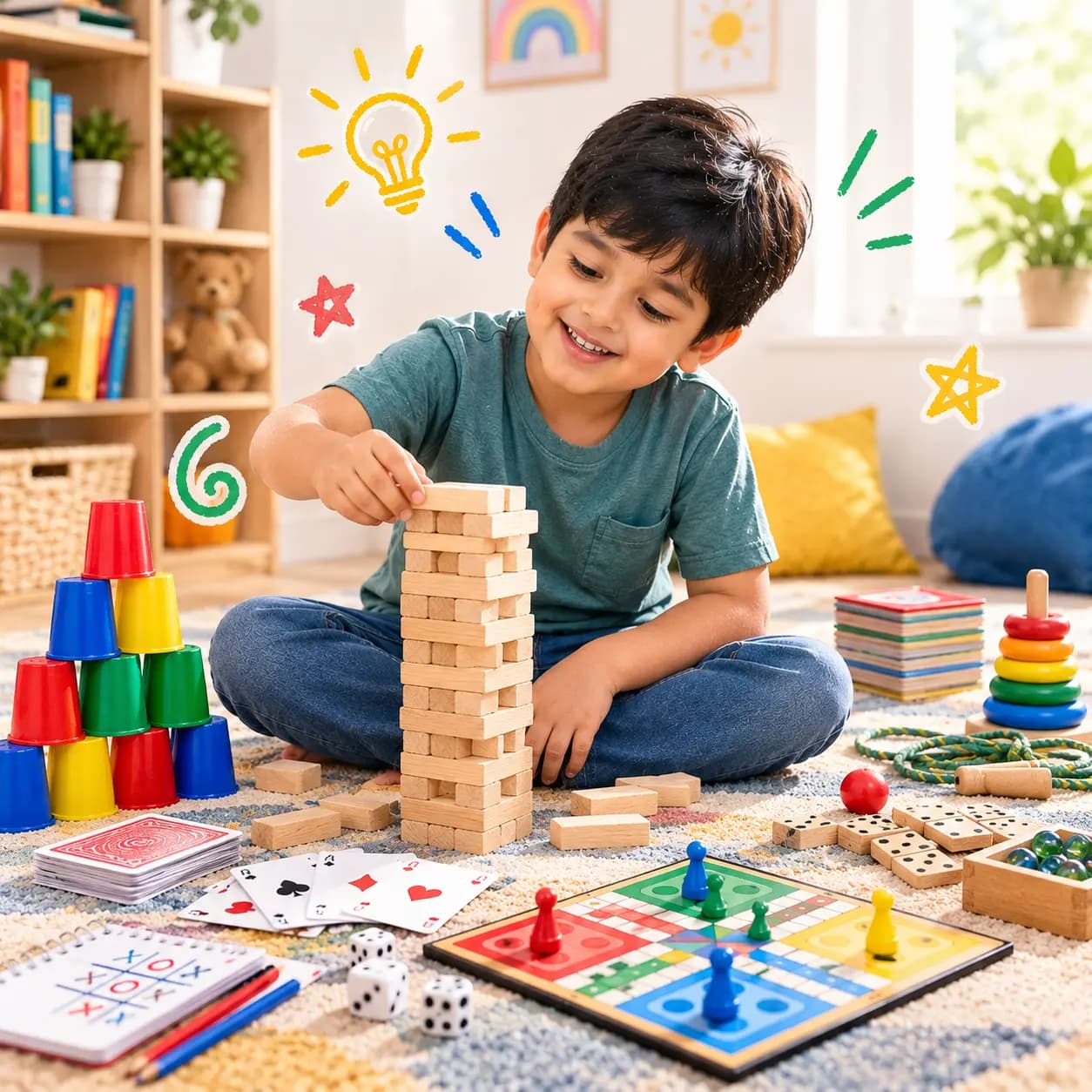
A Jenga set, a pack of cards or a box of blocks is easy to buy. Knowing what to do with it is the hard part. We teach exactly how to play, with clear rules, clever twists and daily challenges.
- Picks under ₹200
- Step-by-step guides
- Fun new twists
- Builds real skills
- Included in every plan
- 7-day money-back guarantee
- On WhatsApp, no app
- For
- Age 3 to 15
- Time
- A few minutes a day
- You need
- A Jenga set (or 30 small blocks), A table
- Cost
- Included in every plan
What is it?
Simple toys and games, and the know-how to make them last.
Picks under ₹200
We suggest good, cheap toys and games: blocks, cards, Jenga, dice and more.
We teach the rules
Clear, short instructions, so nobody argues about “how it goes” and play starts straight away.
Twists to keep it fresh
The same toy becomes a new game every week: new rules, new levels, new challenges.
Skills built in
Each game quietly practises something: counting, memory, patience, planning.
Example: one game, step by step
This is the kind of game that reaches you. (An illustration: the real ones change every day.)
Jenga: the Question Tower
Age 6 to 10You need
- A Jenga set (or 30 small blocks)
- A table
- A few easy question cards
What to do
- 1Build the tower: 3 blocks in each layer, turning every layer across.
- 2On your turn, pull one block and place it on top. Then answer one question card, like “name three round things”.
- 3If the tower falls, count the layers you built together. Try to beat it next time.
Ask your child
“Which block was the safest to pull? How did you know?”
What it builds
- Steady hands
- Patience
- Taking turns
Age by age: what a child plays
The same pack of cards or box of blocks grows with your child.
- Age 3–5
Block builders
Big, safe blocks and very simple rules.
Examples
- Colour sorting with blocks
- Build the tallest tower in one minute
- Match the picture cards
- Age 6–8
Rule followers
First real games with a few clear rules.
Examples
- Memory match with playing cards
- Snap and Go-fish
- Jenga question tower
- Age 9–12
Strategists
Games where thinking ahead wins.
Examples
- Jenga with secret challenges
- Speed-card games
- Dice games with simple chances
- Age 13–15
Game masters
Older children teach the games to others.
Examples
- Invent a new card game and write its rules
- Teach grandparents a game
- Tournament with a score sheet
Why it matters for children
Good play does not need an expensive toy. It needs a good game and someone to play with.
Good play on a small budget
You do not have to keep buying new toys. One simple toy, played in many ways, lasts months.
Rules and fairness
Following rules, waiting for a turn and losing without a fuss are skills that games teach gently.
Patience and steady hands
Pulling a Jenga block slowly is real practice in staying calm and focused.
Thinking ahead
Choosing a card or a block makes a child plan one step in advance.
Games bring people together
Siblings, parents and grandparents can all play the same game.
Fun that lasts
New twists make a familiar toy feel new again, so it does not end up forgotten in a cupboard.
- This is not a shopping list you must follow.
- This is not about expensive toys: most of our picks cost less than ₹200.
More Budget-Friendly Toys ideas
A few more of the kind of ideas you will find. The real ones change every day.
Block colour hunt
Call a colour and race to find all the blocks of that colour.
Card memory pairs
Lay out eight pairs of cards face down and find the matching ones.
Domino chain
Stand dominoes in a line and plan a chain that turns a corner.
Dice race
Roll a dice and walk that many steps. First to the door wins.
Tower of cards
Build the tallest card house you can on a flat book.
Ludo with a twist
Add a rule: land on a star and answer a fun question before you move.
Tips for parents
- Buy one simple toy at a time and learn it well. Many games on one toy beats many toys.
- Write the rules on a small card and keep them in the box, so the game is easy to start next time.
- Change one rule when interest fades. A tiny twist makes an old toy new.
- Teach the game to your child, then let them teach it to a friend. Teaching is the best practice.
How it works
- 1
Choose a plan
Budget-Friendly Toys is included in every PaperCandy.Kids plan. There is nothing extra to pay.
- 2
Tell us your child’s age
We pick the right level and the right language: Gujarati, Hindi or English.
- 3
Ideas arrive on WhatsApp
A fresh activity reaches you every day, with a picture and short steps.
- 4
Play together
Put the phone down and play. Each activity shows what to do and what to ask your child.
Ready to try Budget-Friendly Toys?
Pick a plan, tell us your child’s age, and your first activity arrives on WhatsApp. If you are not happy in the first 7 days, we refund the full amount.